Field guide / 04 / Folding workstations
Fold Up the Working Surface
Reclaim the floor without making every project a furniture-moving exercise. A good folding station is straightforward to deploy, stable in use and secure when stored.
Choose the right kind of folding
A wall-mounted top keeps the floor relatively clear when stored, but it commits the working position to one wall. A freestanding folding bench can move closer to the task, at the cost of a separate storage footprint and a lifting or carrying operation. Neither arrangement is automatically better for a small garage.
Start with the work sequence. If the surface comes out briefly for measuring and light assembly, a quick setup may matter most. If it supports a long session with clamps and awkward parts, access around the edges and a stable support system become more important. Heavy impacts, machinery and significant sideways forces may call for a different workstation entirely.
Measure the folded arrangement honestly. Include projecting brackets, hinges, handles and stored legs. Check that vehicle mirrors, door swings and walking routes still clear the stored unit. A thin top can create a surprisingly deep folded package once its supporting hardware is included.
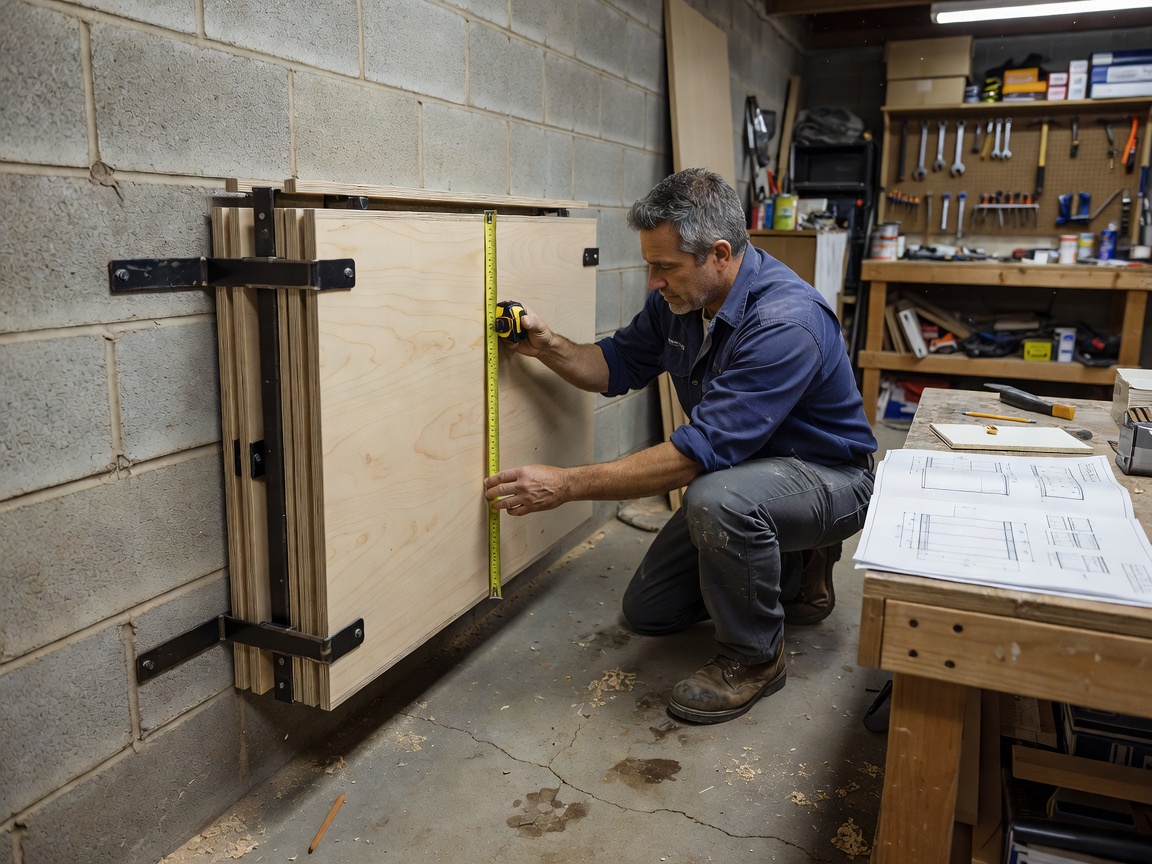
Design the support before the hinge
The hinge controls movement; it is not necessarily the main load-bearing support. Decide how the working surface transfers weight to legs, brackets or a suitable structural frame. Check that supports are intended for the actual direction and distribution of loading, including realistic off-center work.
For wall-mounted designs, identify the wall construction and the structure behind the finish. Plasterboard alone is not a generic structural mounting solution. Studs, masonry, anchors and fasteners require different checks, and hidden services must be located before drilling. Get qualified advice if the construction or capacity is uncertain.
Freestanding designs need bracing against racking and a positive way to hold legs in their working position. Check whether support locks can be seen and reached without placing a hand in a pinch point. Do not assume a friction fit, loose prop or familiar-looking bracket provides adequate restraint.
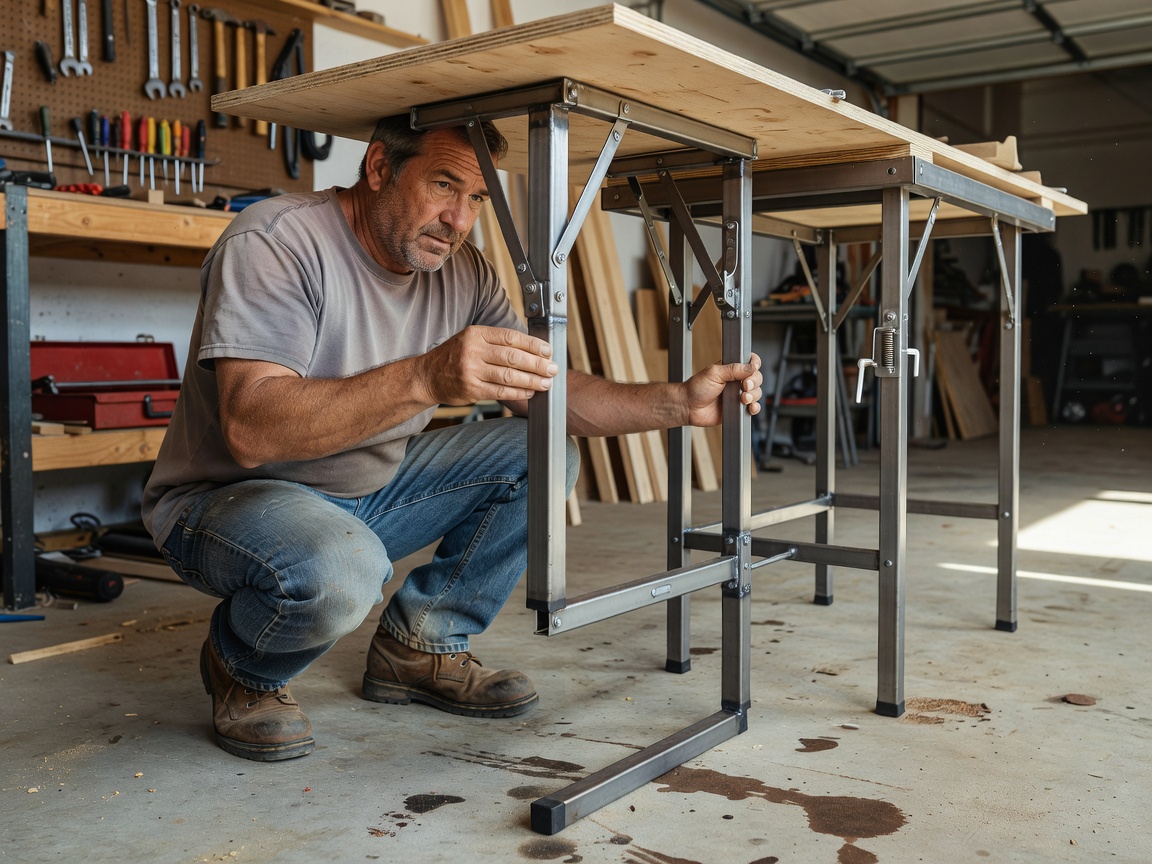
Rehearse the setup with empty hands
Write the operating sequence before final assembly. Where do you stand? Which hand controls the top? When does each support engage? If the answer involves balancing the surface while reaching underneath it, revise the design or plan suitable assistance.
Control the weight throughout the movement. A broad sheet top can be awkward even when its total weight seems modest. Handles, lifting aids and counterbalance hardware must be selected and installed for the design; an improvised assist can introduce a new failure point. Keep other people clear of the swing area during setup.
Stored security matters as much as working stability. Provide an appropriate positive restraint so the top cannot fall open or the folded legs swing into a route. Check that the restraint can withstand the foreseeable conditions and does not rely on an unsecured object placed in front of it.
- Movement envelopeMark the full arc of the top, legs and your own lifting position.
- Support hardwareRetain the installation instructions and check every component’s intended application.
- Pinch-point reviewInspect hinges, folding braces and gaps throughout the entire movement.
Build around a simple inspection routine
- Mock up both positions
Use a lightweight model to check the working height, swing path and stored clearance.
- Confirm the supporting structure
Resolve wall capacity, leg bracing, hardware selection and fasteners before assembly.
- Fit and inspect the mechanism
Check clearances through the complete movement with the surface unloaded and appropriately supported.
- Trial the intended use
Confirm full lock engagement and apply intended loads gradually within verified design limits.
Before every session, check that the supports are fully deployed, the floor is suitable and the top is free of damaged edges or loose hardware. Remove tools and workpieces before folding. Never try to release a support while it is carrying a working load.
A folding station should reduce friction in your day, not encourage rushed setup. If you keep leaving it open because deployment is awkward, simplify the routine or reconsider its location. The most space-efficient design is the one you can use and put away consistently without compromising stability.
Keep the limits clear: These notes do not provide anchor specifications, structural calculations or a safe working load. Those must be established for your particular wall, frame, hardware and task.